Frequently, our patients declared they had disorders that no one believed they had. We had patients who said they had Tourette syndrome (but they didn’t); that they had tic disorders (but they didn’t); that they had multiple personalities (but they didn’t).
The doctors privately recognized these false self-diagnoses as a manifestation of social contagion. They even acknowledged that suicide has an element of social contagion. But when I said the clusters of girls streaming into our service looked as if their gender issues might be a manifestation of social contagion, the doctors said gender identity reflected something innate.
To begin transitioning, the girls needed a letter of support from a therapist—usually one we recommended—who they had to see only once or twice for the green light. To make it more efficient for the therapists, we offered them a template for how to write a letter in support of transition. The next stop was a single visit to the endocrinologist for a testosterone prescription.
That’s all it took.
When a female takes testosterone, the profound and permanent effects of the hormone can be seen in a matter of months. Voices drop, beards sprout, body fat is redistributed. Sexual interest explodes, aggression increases, and mood can be unpredictable. Our patients were told about some side effects, including sterility. But after working at the center, I came to believe that teenagers are simply not capable of fully grasping what it means to make the decision to become infertile while still a minor.
Side Effects
Many encounters with patients emphasized to me how little these young people understood the profound impacts changing gender would have on their bodies and minds. But the center downplayed the negative consequences, and emphasized the need for transition. As the center’s website said, “Left untreated, gender dysphoria has any number of consequences, from self-harm to suicide. But when you take away the gender dysphoria by allowing a child to be who he or she is, we’re noticing that goes away. The studies we have show these kids often wind up functioning psychosocially as well as or better than their peers.”
There are no reliable studies showing this. Indeed, the experiences of many of the center’s patients prove how false these assertions are.
at this part, they describe the physical side effects of the powerful medications given to these kids
Another disturbing aspect of the center was its lack of regard for the rights of parents—and the extent to which doctors saw themselves as more informed decision-makers over the fate of these children.
In Missouri, only one parent’s consent is required for treatment of their child. But when there was a dispute between the parents, it seemed the center always took the side of the affirming parent.
My concerns about this approach to dissenting parents grew in 2019 when one of our doctors actually testified in a custody hearing against a father who opposed a mother’s wish to start their 11-year-old daughter on puberty blockers.
I had done the original intake call, and I found the mother quite disturbing. She and the father were getting divorced, and the mother described the daughter as “kind of a tomboy.” So now the mother was convinced her child was trans. But when I asked if her daughter had adopted a boy’s name, if she was distressed about her body, if she was saying she felt like a boy, the mother said no. I explained the girl just didn’t meet the criteria for an evaluation.
Then a month later, the mother called back and said her daughter now used a boy’s name, was in distress over her body, and wanted to transition. This time the mom and daughter were given an appointment. Our providers decided the girl was trans and prescribed a puberty blocker to prevent her normal development.
The father adamantly disagreed, said this was all coming from the mother, and a custody battle ensued. After the hearing where our doctor testified in favor of transition, the judge sided with the mother.
Given the secrecy and lack of rigorous standards that characterize youth gender transition across the country, I believe that to ensure the safety of American children, we need a moratorium on the hormonal and surgical treatment of young people with gender dysphoria.
In the past 15 years, according to Reuters, the U.S. has gone from having no pediatric gender clinics to more than 100. A thorough analysis should be undertaken to find out what has been done to their patients and why—and what the long-term consequences are.
There is a clear path for us to follow. Just last year England shut down the Tavistock Centre, the only youth gender clinic in the country, after an investigation revealed shoddy practices and poor patient treatment. Sweden and Finland, too, have investigated pediatric transition and greatly curbed the practice, finding there is insufficient evidence of help, and danger of great harm.
Some critics describe the kind of treatment offered at places like the Transgender Center where I worked as a kind of national experiment. But that’s wrong.
Experiments are supposed to be carefully designed. Hypotheses are supposed to be tested ethically. The doctors I worked alongside at the Transgender Center said frequently about the treatment of our patients: “We are building the plane while we are flying it.” No one should be a passenger on that kind of aircraft.
When priests offer the Holy Sacrifice of the Mass unworthily, when they give the Eucharistic Jesus to sinners who have no intention of asking Him to forgive their sin’s or of living according to the gospel, they betray Jesus once again.
When Mass, for the priest, has become a theater, a social gathering, an entertainment in which he behaves like the variety-show host who has to resort to his personal creativity in order to make the atmosphere interesting and attractive; when he indulges in cultural adaptations, personal explanations, and commentaries instead of making room for the ineffable groanings of the Holy Spirit present in every Eucharistic celebration, what becomes of the faith of the faithful?
At the heart of the Eucharist, the priest must experience the unique power of silent adoration and have at heart a prayer that, in all its aspects, is conformed to the prayer that Jesus addresses to His Father. We have enough eminent specialists and doctors in the ecclesiastical sciences.
What the Church tragically needs today is men of God, men of faith, and priests who adore in spirit and in truth.
A book with which to follow Jesus by means of the seven sacraments
The modest purpose of this volume is to accompany all those who have set their hearts on responding to God’s love with a full, happy, fruitful life that will culminate in the eternal happiness of contemplating Him.
The book was born of the desire to help them make an interior journey of spiritual ascent, so as to open up for them the possibility of a life-changing encounter.
Sigh. I haven't been to mass often since covid hit and they limited mass attendence and told elders they couldn't go into church. And since I got Dengue three months ago I don't have the strength to warlk and sit in a hot church. Sigh.
I am probably breaking the copyright law, but no one reads this blog so I am placing this here to read at my leisure.
Fr. Martin's Bridge, Pt. 1: Crossing into Critical Queer Catholicism
The Jesuit's bridge for "LGBTQ" Catholics & the church is constructed with new rules of discourse that use “respect, compassion, and sensitivity" to queer doctrine regarding marriage & the family.
A company of Catholic academics and their allies aim to queer Catholic doctrine regarding Christian anthropology, marriage, and the family by transforming Catholic discourse.
Under the influence of postmodernism’s Critical theories, these Catholics – “thinking not as God does, but as human beings do” – divide the church community into identity groups. To achieve what diversity, equity, and inclusion has already accomplished in our public discourse, they exploit the Christian call to be respectful, compassionate, and sensitive in order to change how the institutional church talks and writes about sex, gender, and sexuality.
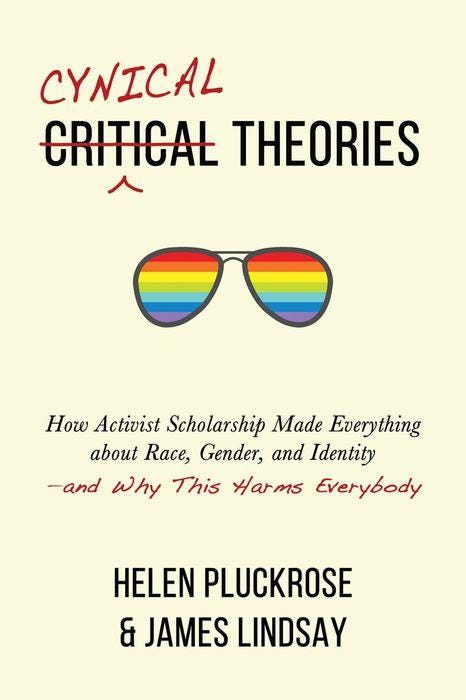
As James Lindsey and Helen Pluckrose explain in Cynical Theories: How Activist Scholarship Made Everything About Race, Gender, and Identity, in Critical theories the individual exists only at the intersection of “the identity groups to which the person in question simultaneously belongs.” Comprising an intolerant identity-based social justice ideology, Critical theories blur all “boundaries between the objective and subjective.” Reality being a “product of our socialization and lived experiences, as constructed” by language, judgments based upon reason, objective knowledge, and universal truth become taboo.
It is Critical Queer Theory that utilizes language as the means for breaking down, undermining, and dismantling norms. In CQT lexicon, to queer anything is to “cast doubt upon its stability, to disrupt seemingly fixed categories, and to problematize” any binaries within them.
Queer theory, which encompasses gender theory, liberates the human being from constraints, challenging the legitimacy of any discourse considered normative and, therefore, oppressive. Queering is, then, an “unmaking of any sense of the normal.”
Since there is little that is more normal than the traditional family, this places the Catholic Church – whose discourse makes it the Defender of Marriage and Family – in the direct line of attack.
Any universal idea emphasizing our common humanity is scorned within queer theory. Science itself is suspect: “there can be absolutely no quarter given to any discourse – even matters of scientific fact – that could be interpreted as promoting or legitimizing biological essentialism.” The bureaucratic scientific and medicalestablishments have already surrendered.
The postmodern Academy’s Critical theories, which have entered our cultural bloodstream at every level, are influencing many Catholic academics and priests, including teachers at Catholic schools. Cynical Theories is perhaps the best introduction to what these theories are and how they are changing Western civilization. James Lindsay’s New Discourses is also a valuable online source.
Bringing the discourse of Christianity into identity compliance is vital. MainstreamProtestantchurches are conforming. The Catholic Theological Society of America, an organization of Critical Catholic theorist-theologians, is on board. Various European prelates – such as Bishop George Bätzing, Cardinal Reinhard Marx, and Jesuit Cardinal Jean-Claude Hollerich – are taking advantage of the current synodal path to pressure the institutional church in this direction. American prelates employ the jargon of Critical newspeak, asserting that the church’s oppressive “structures of exclusion” and “patterns of marginalization” wound various identities, including LGBTQ Catholics.
Few Catholics promote this political project of transformation within the institutional church more sincerely – and astutely – than Fr. James Martin, the thoroughly postmodern Jesuit, who in 2018 asserted that the “most marginalized person in the church” is the LGBTQ Catholic. “There’s no question” about it, he said.
Caesar’s Bridge
Because I am a Catholic who is gay, I have an interest in Fr. Martin’s voluntary ministry to LGBTQ Catholics, a ministry with friends in high places.
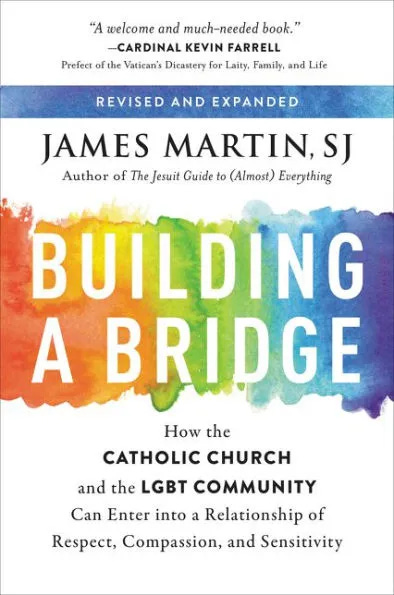
The central argument of Building a Bridge transforms the church from a universal body of believers into a political body divided into identity groups with grievances – in this case, the secular identity involving “sexual orientation and gender.”
A “great chasm..has formed” between the institutional church and the LGBTQ community, whose members have “felt hurt … unwelcomed, excluded, and insulted,” declares Fr. Martin. Because it has made these Catholics “feel marginalized,” the church bears the “primary responsibility” for constructing a bridge of “dialogue and reconciliation” based upon “respect, compassion, and sensitivity.” [Italics in direct quotations throughout this series are mine.]
For church leaders to show “respect” for the group of Catholics whose sexual orientations and gender identities have been “invisible” to it, Fr. Martin says the church must address the group the way it “asks to be called.”
“People have a right to name themselves,” he says. Of course, the “people” naming us are the elite leadership of political organizations, such as GLAAD and the Human Rights Campaign.
No person is LGBTQ. The LGBTQ Catholic, the “most marginalized person in the church,” does not exist. This formulation of intersecting sexual and gender identities bears no relation to the imago Dei. It does, however, represent a political alliance of convenience that is, as Carl Trueman observes, logically incoherent. The sexual orientation of lesbians, gays, and bisexuals is, like that of heterosexuals, rooted in the sex binary, the existence of which is denied by trans men, trans women, and sundry gender identities.
Fr. Martin’s example of “respect”is bunk, but even bunk can serve a serious purpose. As more bishops use the acronym, the desired effect is achieved. A group of Catholics, distinguished from the fold by same-sex attraction and gender identity, are recognized by a Church speaking as Caesar speaks.
Bridge of Transformation
In a queered church, it becomes insufficiently respectful for me to be acknowledged as a person created in the image of God unless my individual humanity is modified. I must be “named” with a group identity, and talked about with an adolescent sense of respect, compassion, and sensitivity.
In the new rules of discourse, compassion and sensitivity, as well as respect, can only be demonstrated through affirmation and acquiescence. Fr. Martin repeatedly asks the institutional church to “listen” to LGBTQ Catholics without stating its Critical theory corollary – listening is transformative because it changes the listener; if transformation has not occurred, neither has listening.
Fr. Martin’s chasm does not exist in the Catholic church, which is our bridge to salvation. What does exist is a group of Catholics who want the church to redefine sin and thereby embrace the secular mores of the State, and who “other” any opposition to their goals as hate.
His ministry is closely aligned with New Ways Ministry, a “Catholic outreach that educates and advocates for equity, inclusion, and justice for LGBTQ+ persons, equipping leaders to build bridges of dialogue with the Church and civil society.” Fr. Martin was its 2016 Bridge Building Award recipient.
Firmly antiracist in its “support of BIPOC communities (Black, Indigenous, and People of Color),” whose liberation is “an integral aspect of our work for LGBTQ equality,” New Ways advances “an intersectional understanding of gender identity and sexuality.” Enthusiastic supporters of Black Lives Matter, which seeks to “disrupt the Western-prescribed nuclear family structure,” New Ways advocates for marriage equality and is sympathetic to the centering of queerness in any Catholic discussions of sex and the family.
What he calls a chasm is a political creation, shaped within an ongoing sexual revolution, egged on by Critical theorists whose intent is to dismantle the most oppressive of power structures: the family – and its major defender, the most significant Christian institution remaining that, thus far, refuses to bend.
His bridge implants within the church the identity politics responsible for the recent rapid acceleration of that revolution.
The Bridge-Builder Ignores the Earthquake
In the introduction to his book’s second edition, Fr. Martin addresses why, in its first, he omitted any discussion of same-sex marriage and homosexual relations: He wants Building a Bridge to focus on areas of commonality – dialogue and reconciliation – because “not everything has to be about sex.”
The “stance” of the church, he explains, and the stance of LGBTQ Catholics on these topics are simply “too far apart”: same-sex relations are, says the church, “impermissible,” but for LGBTQ Catholics “same-sex relations are part-and-parcel” of our lives.
That Fr. Martin refers to church doctrine on these matters as a “stance” is a tell. Political organizations, responding to popular feeling, have stances on issues of the day: the Catholic church has doctrine rooted in objective truth.
Because Fr. Martin avoids truth, his book pulls the reader away from reality into an illusion: Nothing especially unusual has been taking place in society; what is remarkable is the hostility of those who oppose what has been taking place.
When Eve was told, “Your eyes will be opened and you will be like gods,” she was being addressed by the world’s first queer theorist.
The reality is that we witnessed the successful queering of the institution of marriage a mere two years before the 2017 publication of Building a Bridge. What does it tell us about his bridge that the architect ignores a social earthquake of such magnitude?
It is foolish not to appreciate this revolutionary change in the secular institution of marriage. Marriage has been neutered: it is fundamentally sterile and without any immutable limiting principle. Its aftershocks continue.
In the half-decade following Obergefell vs. Hodges, Merriam-Webster, Collins Dictionary and the Macmillan Dictionary no longer mention man and woman in their definitions of marriage. Dictionary.com references the two sexes only when defining an altogether new subcategory, “opposite-sex marriage.”
Children now grow into adulthood unmoored from the historical reality of an institution as it existed for thousands of years. Husbands now marry husbands; wives now marry wives. Secular marriage ratifies a legal partnership of the present, its connection to society’s future – to children – no longer implied.
Simultaneously, woman and man are being redefined. Among the official definitions for woman in the Cambridge Dictionary is “an adult who lives and identifies as female though they [sic] may have been said to have a different sex at birth.” Dictionary.com’s Word of the Year for 2022 is woman because the word, dominating the cultural conversation, “reflects the intersection of gender, identity, and language.”
Maia Kobabe Wrote a Book About Eir Path to Coming Out to Eir Family
Our language’s grammar is reduced to nonsense to appease the adolescent sensibilities of people unable to cope unless the world conforms to their feelings. Adults inform children they can choose their own pronouns, even make up entirely new pronoun forms. Teachers are being required to use them.
Fr. Martin justifies this, suggesting to ordinary folks – and Catholic school leadership – that the refusal to use someone else’s preferred pronouns is “offensive, insulting, and shaming” and compromises the “safety” of LGBTQ people. According to Fr. Dan Horan, a Franciscan theologian much recommended by Fr. Martin, this refusal is “unchristian and sinful.”
Fr. Horan, who is co-teaching a year-long course in Queer Theology – you do realize there is such a theology? – at St. Mary’s College at Notre Dame, finds it disgraceful “that so many of those who self-identify as Catholic use our faith tradition to reject and erase the self-identities of our sisters, brothers and other siblings in Christ.”
What to my “unchristian” ear is bizarre phrasing – “other siblings in Christ” – exhibits sensitivity for the self-creators, who “are” non-binary or gender-fluid or, in some other sense, queer.
God is not the author of this confusion, nor is the institutional church, despite Fr. Martin’s belief that, through its discourse, it is “contributing to division.” The church should be “a sign of unity…in all times,” he says, even as he divides its members into political identities.
Was God’s command regarding the tree of knowledge of good and evil a sign of division or one of unity? Fr. Martin does not say. But when Eve was told, “Your eyes will be opened and you will be like gods,” I imagine she was being addressed by the world’s first queer theorist.
Is “I Do Not Challenge Church Teachings” a Lie?
Whether or not Fr. Martin rejects the church’s teachings on marriage and sexual relations has puzzled some Catholics, perhaps because his writing style possesses a studied elusiveness that provides him plausible deniability.
In the second edition’s chapter regarding “sensitivity,” Fr. Martin decided to add the three paragraphs (2357 - 2359) from the Catechism regarding Chastity and Homosexuality.
Does he use this renewed opportunity to explain Church teaching? No.
Instead, he highlights what he regards as the insensitivity of the church’s “hurtful” discourse, which “needlessly offends” when it declares that a homosexual inclination is “objectively disordered” and that homosexual acts are “intrinsically disordered,... (and) contrary to the Natural Law.”
He concludes by mentioning a comment from the mother of a gay son about the Church’s discourse: for a 14-year-old gay boy to “read language like that…could destroy him,” she says.
Catholic discourse, you see, is violence. It wounds. It nurtures bullies. It leads to suicide.
Using emotional blackmail is standard practice when logic and reason give way to subjectivity. Seeding guilt is effective when your audience includes adults who fear being judged bigots more than they fear lies, and especially effective when your audience includes impressionable teenagers.
He introduces this sensibility in his article in America that more fully elaborates “official church teaching on homosexuality,” foregrounding the suffering of LGBTQ people: many believe “God hates them,” many are “tempted to suicide because of their sexual orientation,” and many “feel that their own church has rejected them.”
But before proceeding to Church teachings on homosexuality, Fr. Martin inserts a personal parenthetical comment: “As a Catholic priest,” he tells us, “I have also never challenged those teachings, nor will I.”
The Bad Teacher
Priests are the church’s front-line teachers in matters of faith and dogma.
But any teacher – even a non-believer – can present information that imparts the “what” of specific church doctrine.
When an English instructor guides his students through Shakespeare’s Romeo and Juliet, for example, he is not simply presenting the words. The duty of a teacher is to light a pathway into the play’s beauty – its poetry and form – so that the reader’s understanding of human nature and the world is thereby enriched. A good educator is able to do this when he has the necessary skills, when he demonstrably loves the work, and when he believes that teaching it has immense value for his students.
Fr. Martin has the skills. But he is convinced church discourse concerning homosexuality is “unnecessarily cruel” and insensitive to “what might hurt or offend someone.” He does not love the work he teaches.
Educators are called to teach the true, the good, and the beautiful. This demands of them a deep appreciation for the judgments of our cultural, intellectual, and spiritual predecessors who have built a civilization. If we cannot guide subsequent generations into this rich heritage, we leave them unable to distinguish between what feels right and what is right.
Fr. Martin fails to mention that the language regarding homosexuality exists within the Catechism’s consideration of the Sixth Commandment, which itself lies within an unfolding tapestry of catechesis regarding our vocation as human beings participating “in the light and power of divine Spirit.” By our reason and free will, we are called to find perfection “in seeking and loving what is true and good” despite our nature bearing “the wound of original sin.” We are, as a result of the Fall, inclined toward evil and subject to error, but through Christ, we are delivered “from Satan and from sin.” (1702 - 1708)
In Church tradition, the Sixth Commandment encompasses “the whole of human sexuality,” which is “ordered to the conjugal love of man and woman.” It is in marriage that “the physical intimacy of the spouses becomes a sign and pledge of spiritual communion.” (2360) It is in this Commandment that all of us are reminded of our vocation to chastity, “the successful integration of sexuality within the person.” (2337)
Respect, Compassion, Sensitivity, and Sodomy
But let’s say the language is changed.
Instead of being “objectively disordered” or “intrinsically disordered,” perhaps the church describes my homosexual inclination and the homosexual acts in which I engage as “differently ordered.” Or perhaps, as the German bishops concluded in a recent Synodal document, my homosexual acts could be considered “not intrinsically bad.”
If homosexual acts are not “disordered,” then God must have ordained them. If they are “not intrinsically bad,” then God must have designed them as good. And since they are part of God’s order or goodness regarding human sexuality, we should have no objection to discussing those “differently ordered” or “not intrinsically bad” homosexual acts.
If sodomy is part of God’s design, are anal and oral sex simply nuanced forms of complementarity? What about mutual masturbation of the genitals? Catholics who support “marriage equality” need not be reticent: Explain how two men having homosexual relations function as “ministers of the design established by the Creator.”
Even now, some Catholic theologians recommended by Fr. Martin, such as Craig Ford at St. Norbert’s College, are developing a more queer natural law theory that would holistically enfold within natural law the sexual inclinations and actions of LGBTQ Catholics.
A change in language in one area of teaching, of course, ripples across others. Respect, compassion, and sensitivity per the new rules of discourse require the church to reconsider its “stance” on the blessings of same-sex unions.
For the church to maintain that “sexuality is ordered to the conjugal love of man and woman” (2360) is micro-aggressive and hurtful, especially as these words immediately follow its teachings regarding homosexuality, an insulting juxtaposition unmentioned by Fr. Martin. That discourse will have to change.
The Fourth Commandment’s descriptions of marriage and the family are neither inclusive nor equitable: to say that a “man and a woman united in marriage, together with their children, form a family” (2202) and that this “Christian family is a communion of persons” who “in the procreation and education of children…reflects the Father’s work of creation” (2205) is heteronormative. This doctrine must be queered.
Catechesis regarding the Sacrament of Matrimony (1601 - 1666) cannot remain unaffected. A conjugal love that “aims at a deeply personal unity…open to fertility” can, if nuanced by theologians, surely encompass sodomy as a metaphorical allusion to fertility.
But let’s say that Church discourse remains as is because it is True.
The Church tells me my homosexual inclination is objectively disordered. Well, what is actually offensive about that to me or any other believing Catholic?
I know God created us male and female. That is objectively true. I know that He created the two so that one completes the other when united as one flesh. I know that this design is essential for life, to the protection of which the Church is always called. I know that this order is essential for our survival as a species.
What could be more Good and Beautiful than such a design? It has been celebrated in the most glorious works of art – painting, literature, sculpture, music and song – since mankind began creating art. What is not to love about this design?
Am I supposed to feel forever wounded because my otherwise ordered gifts don’t include the ordered sexual inclination most men possess? Yes, it can be painful for any kid not to be like “everyone else,” but it is not a calamity. Nor is such pain necessarily of any greater weight than any other person’s. All human beings suffer; suffering is not a competitive event.
A disordered inclination does not separate me or anyone from God or His design. His blessings have provided numerous other gifts ordered to His love and the world He has created for us. My sexual attraction to other men, even when acted upon, does not estrange me from reconciliation with God. We are fallen creatures. We sin, and though sin is not part of God’s design, His love for us is. His graces abound.
It does not help teenagers for educators – adults – to lie to them, nor to nurture the self-pity and sense of victimhood to which adolescents are naturally prone. Fornication is a challenge for heterosexuals as well as homosexuals. Mercy does not require a different discourse because the orientation of Catholics like myself is not ordered to the conjugal love between a man and a woman. Politics does. Mercy requires love and truth. And humor, too.
The institutional church is quite aware that the practice of chastity is “an apprentice in self-mastery,” which is “a long and exacting work.” It “presupposes renewed effort throughout life,” efforts that are “especially intense…when the personality is being formed” during teenage years.
Self-mastery, which ought to be everyone’s quest, arises from training in the virtues which, per C. S. Lewis, forms the chest. Our sins against chastity are simply that — sins – and Catholic educators have a duty to instill in their charges an understanding that sin is real, that sin we will, and that over time, through reason and free will, we can master much of our inclination to sin.
Fr. Martin’s concerns about language in Church doctrine exist within a Critical paradigm that raises the subjective – our feelings – to the level of truth. At its heart lies the devious assumption that human beings who are LGBTQ are so enfeebled by suffering, so wounded by incessant bullying, so weakened of character that they are unable to grasp the logic and beauty of God’s Word.
The Church bars no one from entering. It places no one on the margins. It respects each individual Catholic’s free will and reason. It expects its members to fall – repeatedly. And it provides the richness of the Sacraments by which we, as fallen human beings, may reconcile with God, receive His graces, and be led to eternal salvation.
My diary of what I am thinking, since writing helps me clarify thought.
Mostly rants or thoughts about medicine, politics, and the whole damn thing of life.
Oh, Mahal na Birhen Divina Pastora,
Aba, napupuno ka ng grasya
Sa iyo’y nagpupuri at umaasa,
ang iyong bayan, buong puso at kaluluwa.
Dito sa iyong pambansang dalanginan,
Kami’y dumudulog, tuloy nagpupugay.
Aming ihahain, mga karaingan
Inang maawain, kami ay tulungan. (Cantabile)
Lubos ang pag-asa, Ina naming Birhen
Na ang aming daing at pananalangin.
Ay iyong tutulutan, sukat makarating
Sa Poong Diyos Ama, tunay na butihin
Maraming salamat mahal naming Ina
Sa mga biyayang aming tinamasa
Sa mga panganib kami ay iadya.


 PHILIPPINE BISHOPS BLOGS